

When a contractor brings temporary skilled tradespeople onto a project, there is often pressure to get them productive immediately.
The project is behind schedule. The crew needs help. The superintendent needs electricians, carpenters, plumbers, laborers, or other skilled workers on the job now.
But taking 20 or 30 minutes to properly orient a new temporary employee can be some of the most important time spent that day.
A temporary worker may already know the trade. What that worker does not know is your jobsite.
Every Jobsite Is Different
Even an experienced tradesperson walking onto a new project for the first time does not automatically know:
- Where emergency exits and evacuation routes are located
- Where first-aid supplies and fire extinguishers are kept
- Who the competent person or site safety contact is
- What areas are restricted
- What fall-protection requirements apply
- What equipment they are permitted to operate
- Where overhead, underground, electrical, or other hazards exist
- What PPE is required for that particular project
- How injuries, near misses, and unsafe conditions must be reported
- What site-specific rules the general contractor or owner has established
These are not things a staffing or recruiting company located miles away can adequately teach an employee before arrival.
They must be communicated at the jobsite.
OSHA Does Not Treat Temporary Workers as a Separate Class of Employee
One of the biggest mistakes a contractor can make is thinking, “They aren’t our employee. They’re from the staffing company.”
From a safety standpoint, that distinction does not eliminate the host employer’s responsibilities.
OSHA has repeatedly emphasized that staffing agencies and host employers share responsibility for protecting temporary workers. Each employer is responsible for the areas of safety and health that it controls.
The staffing company should make reasonable efforts to ensure workers are qualified for the assignment, understand general workplace safety expectations, and are not knowingly placed into hazardous situations for which they are unprepared.
But the host employer controls the jobsite.
The host knows the equipment, work processes, changing job conditions, other subcontractors, restricted areas, site rules, and specific hazards employees will encounter.
That is why jobsite-specific safety orientation needs to come from the contractor controlling the work.
“He Has Been Doing This for 20 Years” Is Not an Orientation
Experience matters.
But experience on another contractor’s project does not equal knowledge of yours.
A journeyman electrician may have 20 years of experience and still have no way of knowing that:
- A particular electrical room is energized
- Another subcontractor removed a guardrail that morning
- A certain lift is out of service
- A portion of the site requires additional PPE
- Deliveries create a struck-by hazard at certain times
- A specific stairwell is the designated emergency exit
Skill and site knowledge are two different things.
A qualified tradesperson still needs to be introduced to the environment in which that skill will be used.
Who Is Responsible When a Temporary Worker Gets Hurt?
This is where contractors should pay close attention.
OSHA’s Temporary Worker Initiative makes clear that host employers and staffing agencies can both have responsibilities for temporary worker safety.
In many temporary-worker arrangements, however, the host contractor provides the employee’s day-to-day supervision and controls the conditions under which the employee performs the work.
That has important consequences.
For OSHA injury and illness recordkeeping purposes, the employer providing day-to-day supervision generally records a recordable injury or illness on its OSHA 300 Log—even when the worker’s paycheck comes from a staffing company.
So simply saying, “He’s a temp,” does not necessarily move an injury off the contractor’s OSHA record.
More importantly, it does not move responsibility for preventing the injury in the first place.
A Short Orientation Can Prevent a Long List of Problems
A good temporary-worker orientation does not have to be complicated.
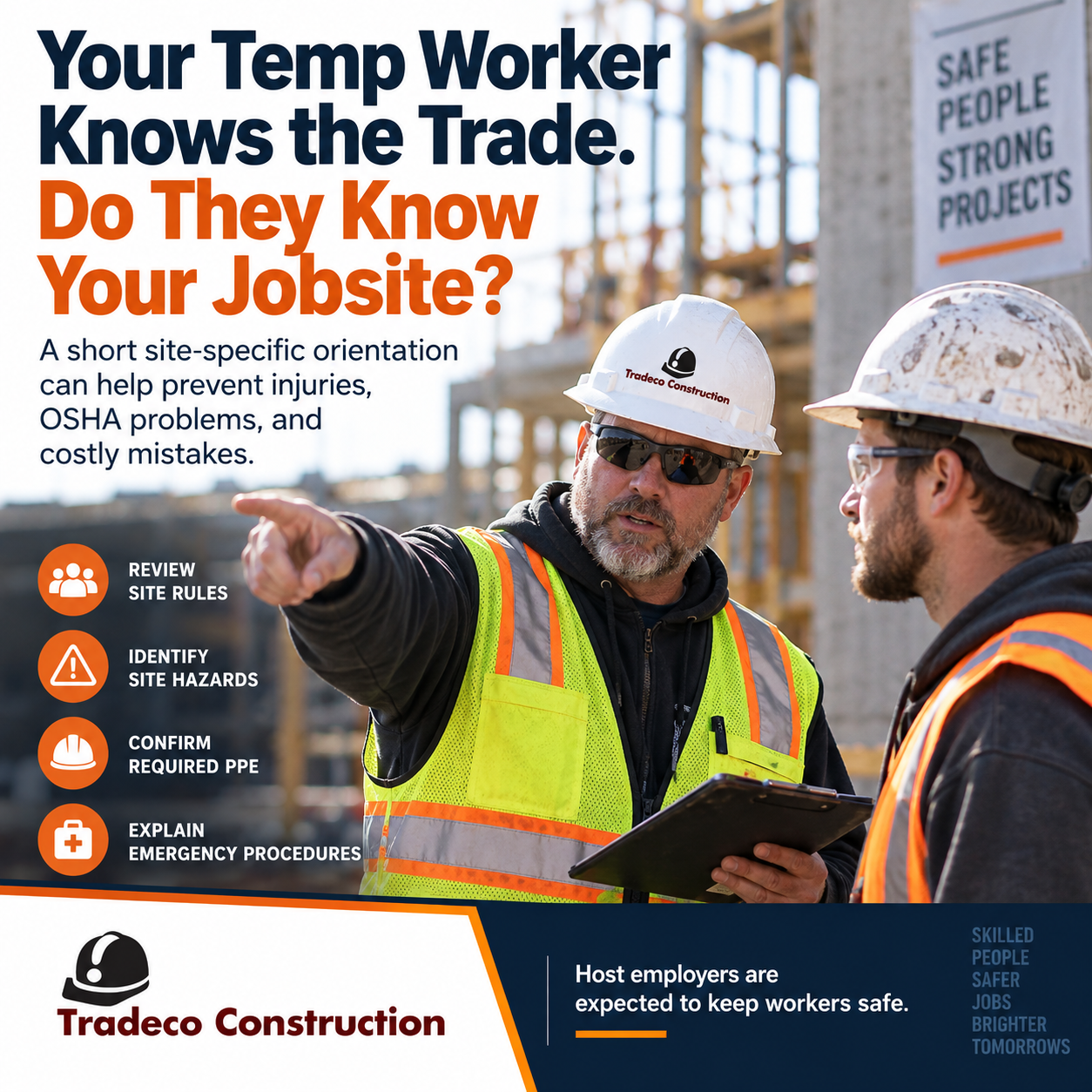
Before putting a new worker into production, contractors should make sure someone takes the worker through the basics:
- Explain the worker’s assignment and limitations.
- Identify the supervisor and safety contact.
- Review required PPE.
- Identify site-specific hazards.
- Explain fall-protection requirements where applicable.
- Review equipment the employee may and may not operate.
- Show emergency exits and assembly areas.
- Explain injury and near-miss reporting procedures.
- Review any GC- or owner-specific safety requirements.
- Give the employee an opportunity to ask questions before starting work.
Documenting that orientation is also a good practice.
A simple signed orientation checklist can demonstrate that important information was communicated and helps ensure supervisors do not accidentally skip critical subjects.
Twenty Minutes Is Cheap Compared With an Injury
Construction moves fast.
We understand that better than most.
When a contractor requests additional skilled tradespeople, it is usually because there is work that needs to get done immediately.
But bringing a worker onto a project and sending that person directly into production without an orientation is a shortcut that can create serious consequences.
An experienced temporary employee should be able to arrive ready to perform the trade.
The contractor still needs to provide the final piece of the puzzle:
How to perform that work safely on this particular jobsite.
At Tradeco Construction, we believe safety works best when contractors, workers, and skilled trades recruiting partners each understand their responsibilities and communicate with one another.
Temporary may describe the length of an assignment.
It should never describe the level of attention given to a worker’s safety.